
Our Recommended Books
Welcome to our digital collection of research and publications. Our curated selection of open-access books provides deep insights into archaeology and Buddhist studies. Explore a wide range of academic titles and resources, to support your studies and your passion for discovery.
Uḍḍiyāna
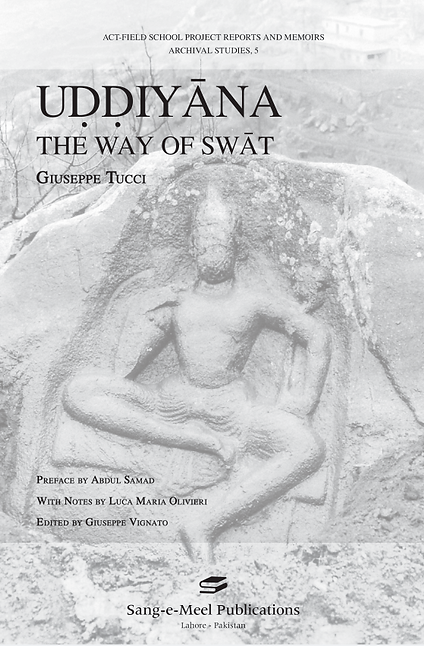
Uḍḍiyāna: The Way of Swāt
By Giuseppe Tucci
Edited by Giuseppe Vignato | With Notes by Luca M. Olivieri | Preface by Abdul Samad
We are proud to announce the publication of Uḍḍiyāna: The Way of Swāt, released in 2025 by Sang-e-Meel Publications under the auspices of the WAKSAW–Uḍḍiyāna Archaeological Alliance.
This commemorative volume marks the 70th anniversary of the Italian Archaeological Mission in Swat (1955–2025) and brings together two of Tucci’s seminal works—Travels of Tibetan Pilgrims in the Swāt Valley (1940) and La Via dello Swāt (1963/1978)—enriched with new notes and illustrations spanning seventy years of archaeological research.
Featuring historic and contemporary photographs, updated maps of pilgrimage routes, and new insights into Swat’s layered past, the book highlights the enduring importance of Swat as a crossroads of civilizations and a spiritual homeland of Vajrayāna Buddhism.
Published by Sang-e-Meel Publications, Lahore
ISBN: 978-969-35-3691-1
Application is no longer available.
Talking Stones:
Unveiling the Sacred Landscapes of Swat-Malakand
The Swat Valley, often revered as the "Holy Land" of Gandhara, is famous as a cradle of Buddhist spirituality. However, groundbreaking research by the Italian Archaeological Mission in Pakistan (IAM) reveals that its stones whisper of a much older, deeper heritage. Traditionally, scholars focused on the serene devotional reliefs of late Buddhism. Luca Olivieri’s work radically shifts this perspective by documenting a massive, previously overlooked corpus of "non-Buddhist" rock paintings. These painted shelters, found in the rugged terrain between the Swat District and Malakand Agency, represent a historically significant tradition that predates or runs parallel to Buddhist imagery, providing a vital missing link in the region’s cultural evolution. A central theme of the research is cultural continuity. Olivieri argues that marking the landscape—whether through archaic geometric incisions, complex cup-marks, or Buddhist figures—was an essential "cultural marker" for Swat’s inhabitants.
Published by: Sang-e-meel Publications, Lahore
ISBN: 9693528883
Application is no longer available.


Vajirasthāna
Archaeology of the Barikot Hilltop (Swat, Pakistan) - Luca M. Olivieri
The present book, by Luca Maria Olivieri and his collaborators, takes its title from the toponym Vajirasthāna, occurring in a Śāradā inscription found at Barikot and transferred to the Lahore Museum in 1898. The three volume book offers an immersive look at the recent 2022–2024 project, supported by the ALIPH Foundation, which focused on the vital restoration of the Barikot hilltop acropolis and its monumental terraces. Moving beyond a simple archaeological report, the text weaves together a narrative of international cooperation involving scholars from across the globe and a deep-rooted partnership with the Pakistani authorities. It highlights a modern, multidisciplinary approach where traditional field data meets cutting-edge technology, including 3D reconstructions and digital documentaries accessible via links within the pages. By combining scientific rigor with an engaging, discursive style, this work serves as both a record of monumental achievement and a guide for future discovery.
Published by: Sang-e-meel Publications, Lahore
Ebook
The new Swat Archaeological Museum
Architectural Study, Master Plan and Execution
The 2011 publication "The New Swat Archaeological Museum: Architectural Study, Master Plan and Execution," authored by Ivano Marati and Candida Maria Vassallo , is a critical case study in contemporary Mediterranean and Asian museology. It documents the ambitious project of reconstructing and modernizing the Swat Museum in Saidu Sharif, Pakistan, following its partial damage during the regional crisis of 2008–2009. This volume provides a comprehensive technical record of how international archaeological missions can integrate heritage preservation with modern architectural requirements.
The text is structured as a technical and methodological manual for monumental restoration. It details the master plan—a collaborative effort between the Italian Archaeological Mission and local authorities—which aimed not only to house the world-class Gandharan collection but also to create a seismic-resistant, sustainable cultural hub.
The authors provide an in-depth analysis of the structural interventions, focusing on the synthesis between the original 1963 design by Vittorio Cabiati and the new functional expansions required for modern archival and exhibition standards.
Published by: Sang-e-meel Publications, Lahore
ISBN: 9693526643
Application is no longer available.

Buddhist Architecture in the Swat Valley, Pakistan
Stupas, Viharas, a Dwelling Unit

This volume offers a comprehensive investigation into the Buddhist monumental heritage of the Swat Valley, Pakistan, based on decades of fieldwork by the Italian Archaeological Mission (IsMEO/IsIAO).
Moving beyond traditional excavation reports, the book provides a sophisticated analysis of how stupas, viharas, and monasteries were masterfully integrated into the natural landscape to form complex sacred ecosystems.
The core of the study examines the large stupas situated outside the primary excavation zones, such as the iconic Amluk Dara, Shankardar, and the sprawling complex of Tokar Dara.
Richly illustrated with technical surveys, plan views, and axonometric reconstructions, this work serves as a vital archive of a vanishing heritage. Many of the monuments described were surveyed in 1993 and have since suffered significant degradation or total disappearance.
By documenting these sites with clinical precision, the volume fulfills the scientific vision of Domenico Faccenna, providing a firm foundation for understanding the evolution of Gandharan architecture and the social organization of the monastic communities that once flourished in the Swat Valley.
Published by: Sang-e-meel Publications, Lahore
ISBN: 969352683X